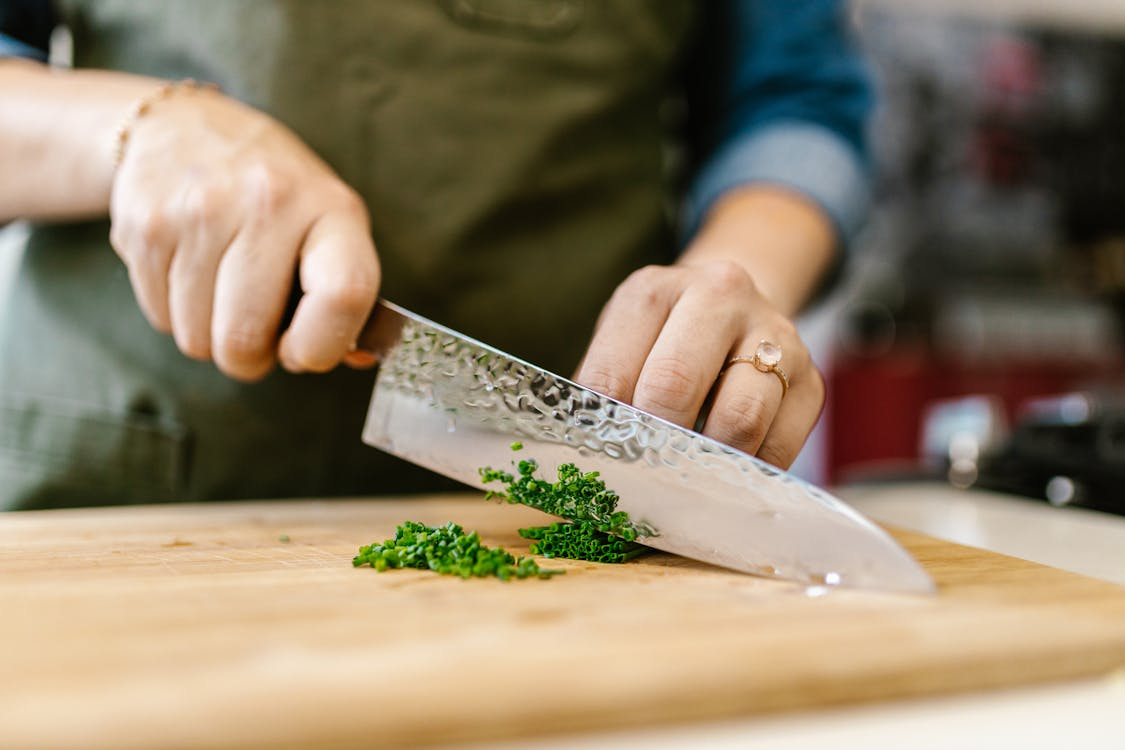
A sharp knife in skilled hands is a cook’s most important tool. Whether you’re preparing vegetables for soup, trimming meat, or chopping herbs, mastering basic knife skills enhances safety, efficiency, and precision.
Excellent knife skills don’t just look impressive. They make cooking more enjoyable and your dishes more consistent.
Choosing the Right Knife for the Job
Different knives are designed for specific tasks. The chef’s knife is your all-purpose workhorse, perfect for slicing meats, chopping vegetables, and even mincing herbs. The paring knife handles smaller, delicate jobs like peeling or coring fruit, while a serrated knife is ideal for cutting bread or tomatoes without crushing them.
If you’re starting with just one knife, invest in a high-quality chef’s knife that feels balanced in your hand. It should have enough weight to cut smoothly, but not so heavy that it tires your wrist. Always keep it sharp. Dull knives are far more dangerous because they require extra pressure and are prone to slipping.
For more smart upgrades, see Kitchen Gadgets That Are Actually Worth Buying.
The Foundation: Grip and Stance
How you hold your knife determines control and accuracy. For most tasks, use the pinch grip. This knife technique involves pinching the blade just above the handle with your thumb and forefinger, then wrapping the other fingers around the handle. This gives you better leverage and precision than holding it like a hammer.
Next, your stance. Keep your feet shoulder-width apart and position your cutting board at a comfortable height. Around waist level is recommended. Tuck the fingers of your non-cutting hand into a “claw” shape to protect your fingertips, with your knuckles guiding the side of the blade as you cut.
Mastering the Slice, Dice, and Mince
Slicing involves cutting food into even, thin pieces. Use a smooth, forward-and-down motion rather than pressing straight down. Let the knife’s sharpness do the work. This technique is ideal for vegetables, fruits, and meats that need uniform thickness for even cooking.
Dicing means cutting food into small cubes. First, slice your ingredient into uniform planks, stack them, then cut crosswise into strips and again into cubes. Consistent size ensures everything cooks evenly and looks professional in the finished dish.
Mincing creates tiny pieces, often used for garlic, onions, or herbs. Start with a fine chop, then use a rocking motion, keeping the knife tip anchored while moving the heel up and down. Gather the pieces with the flat side of the blade and repeat until the texture is uniform.
Explore The Difference Between Sautéing, Pan-Frying, and Stir-Frying for a look at how even cuts affect cooking.
Safety and Maintenance Tips
Always work on a stable cutting board. Place a damp towel underneath to prevent slipping. When passing a knife to someone, offer the handle first and place it flat on a surface if possible. Never leave knives in a sink full of water, as they’re easy to grab by mistake and cause injury.
To maintain sharpness, hone your knife with a steel before each use to realign the edge, and sharpen it regularly with a whetstone or professional service. Hand wash and dry immediately; dishwashers dull and damage blades over time.
Also read The Art of Seasoning Cast Iron Pans for long-lasting cookware.
Practice Makes Perfect
Like any skill, knife mastery comes with practice. Start slow, focus on form, and aim for consistency rather than speed. Over time, your cuts will become faster, cleaner, and more confident. With a sharp knife and the proper technique, even the most mundane prep work feels satisfying. This is a true sign you’re cooking like a chef.